If you have read anything about BYD in the last five years, you have seen the Blade Battery. BYD launched it in 2020, demonstrated it passing a nail-penetration test without smoke or fire, and has since put it into nearly every electric car it sells — from the Atto 3 compact SUV to the Han luxury sedan. Here is what it actually is, what it is good at, and where the marketing ends and the trade-offs begin.
The Short Definition
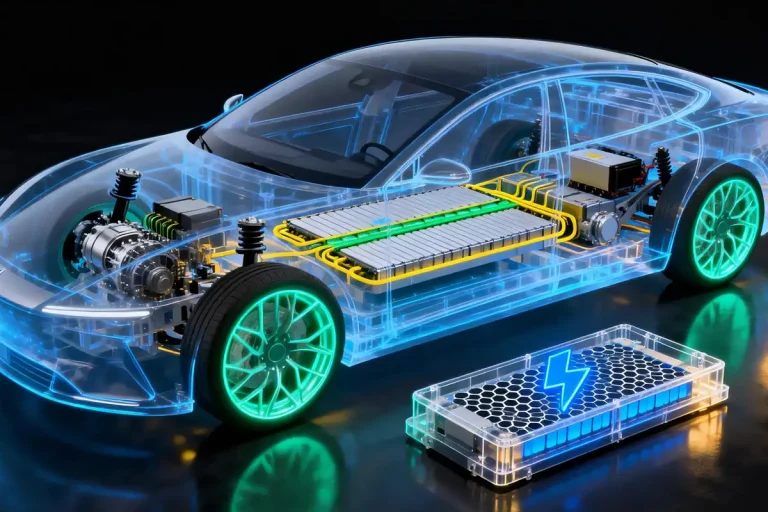
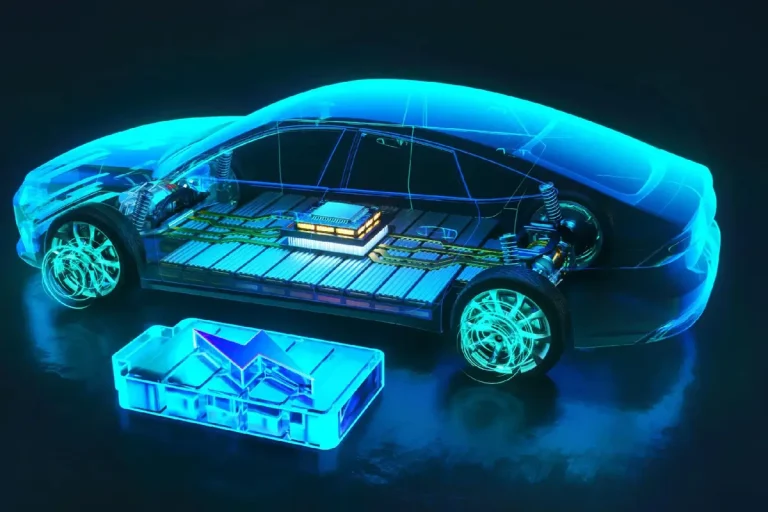
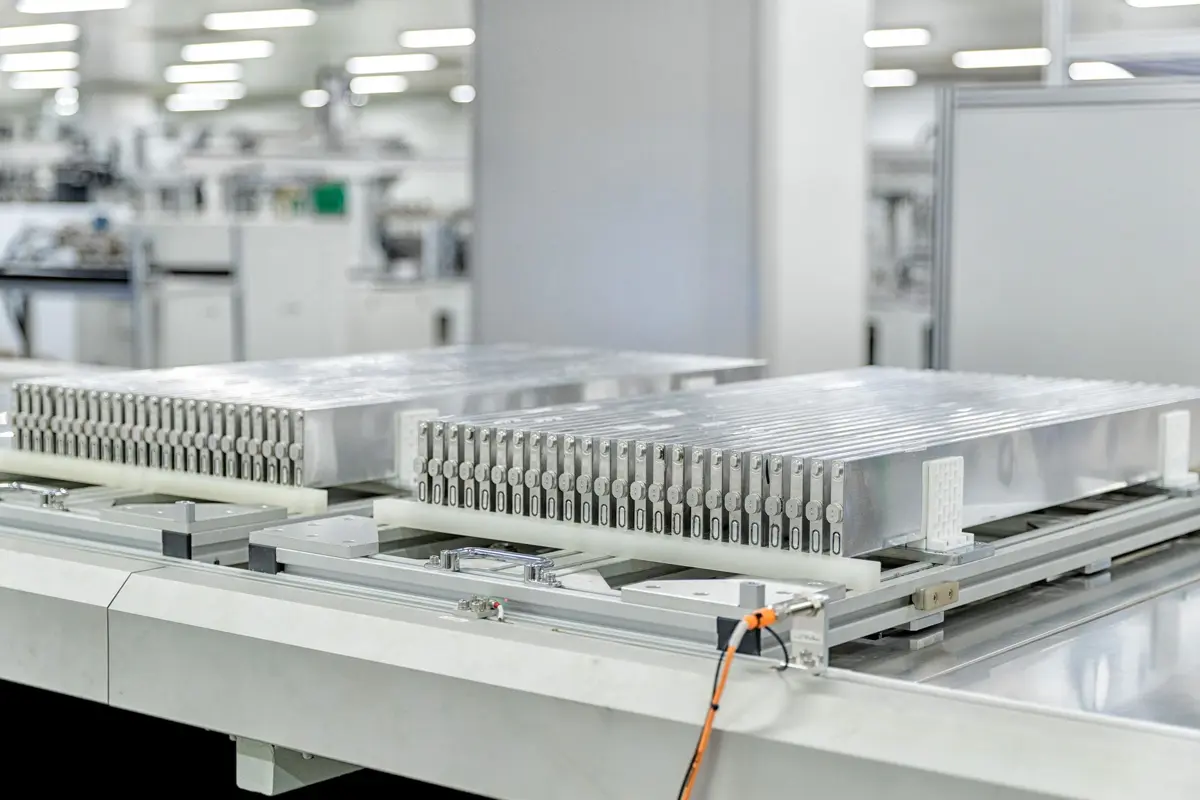
The BYD Blade Battery is a lithium iron phosphate (LFP) traction battery built with long, thin, shaped cells that are packed directly into the battery housing — a design BYD calls “cell-to-pack,” or CTP. The “blade” name comes from the elongated, almost flat cell shape (roughly 96 cm long and 9 cm wide, varying by application) that slides into the pack like a slat.
That definition matters: Blade Battery is not a brand-new chemistry. It is LFP — the same family chemistry used by Tesla’s entry-level Model 3/Model Y, by the Renault 5, and by many Chinese EVs. What BYD did differently is package LFP into long, structural cells and remove much of the module layer between cells and pack.
How It Works
A conventional LFP pack groups cells into modules, then bundles those modules into the housing. That leaves structural overhead — frames, brackets, wiring, cooling ducting — that takes up space but stores no energy.
The Blade design arranges the long cells directly into the pack, acting as both energy storage and structural reinforcement. BYD says this raises pack-level space utilisation by more than 50% compared with conventional LFP block-pack designs. Fewer parts, more cells per litre of pack volume, and a stiffer underbody.
Chemically, the cathode uses lithium iron phosphate (LiFePO₄) instead of the nickel-manganese-cobalt (NMC) chemistry used in most long-range EVs from Porsche, Hyundai, Kia, BMW and, until recently, Tesla’s longer-range models. LFP is thermally more stable: it does not release oxygen at high temperatures the way NMC cathodes can, which is the chemical root of thermal runaway.
The Nail-Penetration Test — and What It Actually Shows
BYD’s signature demo drives a steel nail through a Blade cell to simulate an internal short circuit caused by crash debris or a puncture. BYD shows the cell surface staying relatively cool, with no smoke and no fire. The same test on an NMC cell, BYD says, produces surface temperatures of 500–1,000 °C and open flame.
Take the demo seriously but keep it in proportion:
- It is a valid demonstration of LFP’s thermal advantage, not a crash test. Real-world crash safety depends on the whole pack structure, BMS, cooling system and how the car is engineered — not just the cell chemistry.
- It is a BYD-conducted demonstration. Independent third-party reproductions are limited.
- It does not mean a Blade-powered BYD is automatically safer in every crash. It means the cell itself is less prone to thermal runaway when shorted.
The Real Advantages
1. Thermal safety in hot climates. LFP’s higher thermal tolerance is a genuine advantage in Southeast Asia, Australia, the Middle East and the southern United States, where batteries live in a permanently warm environment.
2. Long cycle life. BYD quotes more than 5,000 charging cycles for Blade LFP, versus roughly 1,000–2,000 cycles for typical NMC cells. In practical terms, that is why BYD can offer 8-year/160,000 km battery warranties with confidence.
3. Cobalt- and nickel-free cathode. Beyond the cost benefit, this sidesteps the ethical and supply-chain concerns around cobalt mining.
4. Tolerance to daily 100% charging. NMC batteries prefer a 20–80% window to stay healthy. LFP is much more tolerant of being charged to 100% every night — which is exactly how most families actually use their car.
5. Simpler, cheaper thermal management. LFP’s stability gives engineers more margin when designing the cooling system.
The Real Trade-Offs
1. Lower energy density than NMC. LFP stores less energy per kilogram. To reach the same range as an NMC pack, a Blade pack has to be physically bigger and heavier. This is why BYD’s performance models (Sealion 7 AWD, Denza Z9 GT) chase range with more kWh rather than with chemical efficiency.
2. Cold-weather range loss is worse. LFP loses a larger share of its range in freezing conditions than NMC, partly because its lower internal resistance means less self-warming. BYD quotes more than 70% capacity retention at –20 °C for first-generation Blade — a manufacturer figure, not an independent test — but the practical takeaway is that Nordic winters are still NMC territory.
3. First-generation DC charging speed was modest. Early Blade packs charged at roughly 88–150 kW peak depending on model. That is fine for home-charging families, but it trails the 250–350 kW peaks of newer NMC-based rivals. Blade Battery 2.0 is BYD’s answer to this.
4. Heavier packs affect handling and efficiency. A Blade-powered compact SUV (Atto 3) weighs around 1,750 kg. The same weight penalty shows up in tyre wear and brake wear.
Blade Battery 2.0 (2026)
In March 2026, BYD unveiled Blade Battery 2.0 alongside its “FLASH Charging” technology. Headline claims:
- About 5% higher energy density than first-generation Blade.
- 10–70% charge in ~5 minutes, 10–97% in ~9 minutes at a compatible charger.
- Retained flash-charging capability at –30 °C (adding only a few minutes).
- CLTC range up to 1,000 km on top-spec configurations.
- A new solid-electrolyte-interphase (SEI) engineering and restructured anode.
Two important caveats:
- These are manufacturer claims under idealised conditions. Real-world speed depends on charger power, cable cooling, battery temperature and state of charge — not just the car.
- The first car to ship with Blade 2.0 and FLASH Charging is the Denza Z9 GT (BYD’s premium brand). It will take time — likely 12–24 months — before 2.0 reaches mainstream models like the Atto 3 or Sealion 7 in export markets.
If you buy a BYD in 2026, you are almost certainly still getting first-generation Blade. That is not a bad thing — it is a proven, durable chemistry — but do not expect FLASH Charging speeds on a standard Atto 3.
Which BYD Cars Use It?
The Blade Battery spans the BYD range: the Dolphin (compact hatchback), Atto 3 (compact SUV), Seal (mid-size sedan), Sealion 7 (mid-size SUV), Han (luxury sedan) and Tang (large SUV). It also powers BYD’s DM-i plug-in hybrid models in a smaller, lower-voltage configuration. Across export markets in Europe, the UK, Australia, Southeast Asia and the Middle East, nearly every BYD passenger EV you can buy today uses first-generation Blade LFP.
What It Means for You as a Buyer
- If you mostly drive around town, charge at home, and live in a warm climate: Blade LFP is an excellent fit. You can charge to 100% every night, the battery will outlast the car’s finance, and thermal safety is not something you need to think about.
- If you regularly do long motorway trips in cold countries: compare carefully with an NMC rival. The range gap in winter is real.
- If you need ultra-fast charging on every road-trip stop: wait for Blade 2.0 to reach your model, or look at a car already on a high-voltage (800 V) platform.
- If battery warranty matters to you: the 5,000-cycle life is the technical reason BYD can back an 8-year/160,000 km battery warranty. Read the fine print on capacity retention and transferability, though.
Bottom Line
BYD’s Blade Battery is not a miracle. It is a well-executed LFP cell-to-pack design that trades a little energy density and cold-weather range for thermal safety, long cycle life, cobalt freedom and the freedom to charge to 100% every day. For most families in most climates, those trade-offs are worth making. The 2.0 generation, when it reaches mainstream showrooms, closes the last obvious gap — charging speed — but it is not yet the battery in the car you can drive home today.